
TWI logo The Washington Institute for Near East Policy
logo
wordmark
Homepage

Main navigation

  • Analysis
  • Experts
  • About
  • Support
  • Maps & Multimedia
Trending:
  • Military & Security
  • Energy & Economics
  • Iran
  • Lebanon
  • Gulf States

Regions & Countries

  • Egypt
  • Gulf States
  • Iran
  • Iraq
  • Israel
  • Jordan
  • Lebanon
  • North Africa
  • Palestinians
  • Syria
  • Turkey

Issues

  • Arab & Islamic Politics
  • Arab-Israeli Relations
  • Democracy & Reform
  • Energy & Economics
  • Great Power Competition
  • Gulf & Energy Policy
  • Military & Security
  • Peace Process
  • Proliferation
  • Terrorism
  • U.S. Policy
TWI English
TWI Arabic: اللغة العربية Fikra Forum

Breadcrumb

  • Policy Analysis

Great Power Competition

Policy Analysis on Great Power Competition

Filter by:

Montage: Presidents Sisi (Egypt) and Putin (Russia) at the 2024 BRICS summit; a woman holds a Russian flag in Istanbul; a Russia House cultural center in Syria; a map image superimposing Russian flag over Africa/Middle East.
Video
Brief Analysis
Russia, the Iran War, and the Middle East
Join us for an expert conversation exploring how the Iran war will change Russia's ambitions in the Middle East. Featuring Keith Kellogg, Anna Borshchevskaya, and Matt Tavares. Watch live starting at 12:00 noon EDT (1600 GMT) on Thursay, July 9, 2026.
July 9, 2026, starting at 12:00 noon EDT (1600 GMT)
◆
  • Keith Kellogg
  • Anna Borshchevskaya
  • Matthew Tavares
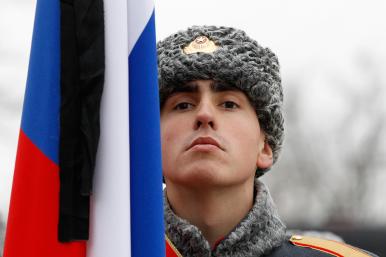
A Russian soldier and flag
Articles & Testimony
Moscow and the Middle East
Whatever course Iran and the wider Middle East may take following the war, Russia is well positioned for the aftermath.
Summer 2026
◆
  • Anna Borshchevskaya
France's President Macron greets the UAE's President Mohamed bin Zayed at the 2026 G-7 summit - source: Reuters
Articles & Testimony
An Emerging International Partnership Is Succeeding
By incorporating Ukraine and other like-minded states from the Middle East and Asia, the G7 Summit highlighted the net progress made on countering Iranian, Russian, and Chinese threats to the American-led global security and economic system.
Jun 24, 2026
◆
  • James Jeffrey
Egyptian troops cross a makeshift bridge over the Suez Canal in 1956 - source: Wikimedia Commons
Articles & Testimony
Is Iran America’s Suez Crisis? Not to Xi Jinping
Some may read Xi’s approach as a strategy to make America expend its strength far from Chinese shores, but Beijing increasingly looks more like a regional power than a global superpower.
May 26, 2026
◆
  • Michael Singh
Turkish president Erdogan at NATO headquarters in Brussels
Brief Analysis
Turkey’s Limited Role in the Iran War
Power parity informs the view from Ankara, which has a strong interest in preventing Iran from going nuclear or alternatively falling into chaos—even as the war’s outcome will be largely outside Turkish control.
May 26, 2026
◆
  • Soner Cagaptay
Brief Analysis
Iran’s Drone Strategy (Part 2): Preventing Postwar Rebuilding and Advancements
Tehran’s drone ecosystem has been hit hard, but not at its roots—with help from Russia and China, the regime could restore many of the program’s capabilities within months while steadily working toward more dangerous next-generation models.
May 22, 2026
◆
  • Farzin Nadimi
Chinese president Xi walks with U.S. president Trump in Beijing in 2017 - source: Reuters
Brief Analysis
Trump’s China Trip: Implications for the Middle East and Beyond
The first presidential visit to China in nearly a decade will cover trade, technology, and a range of other bilateral topics, including frank conversations on Middle East subjects such as Beijing’s support to Iran and the wider global repercussions of the Strait of Hormuz crisis.
May 13, 2026
◆
  • Grant Rumley
  • Henry Tugendhat
  • Elizabeth Dent
  • Anna Borshchevskaya
  • Souhire Medini
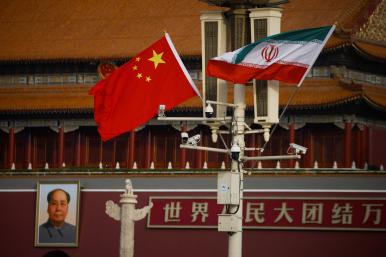
The national flags of China and Iran fly in Tiananmen Square during Iranian President Ebrahim Raisi's visit to Beijing, China, February 14, 2023 - source: Reuters
Articles & Testimony
Is There a China Strategy Behind the Iran War?
The Trump administration’s inconsistent China policy is undermining efforts to parlay the conflict into a geopolitical win.
May 4, 2026
◆
  • Michael Sobolik
  • Grant Rumley
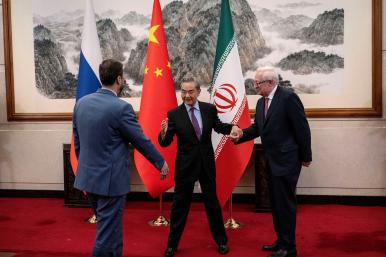
Chinese Foreign Minister Wang Yi greets Russian Deputy Foreign Minister Sergey Ryabkov and Iranian Deputy Foreign Minister Kazem Gharibabadi in Beijing in March 2025 - source: Reuters
Video
Brief Analysis
Wartime Support to Iran: Implications for the Middle East and Beyond
Three experts explore the regional and global implications of Russian and Chinese support for Tehran, including how much this assistance actually affects U.S. efforts to weaken the regime’s capabilities and bring the crisis to an end.
Apr 24, 2026
◆
  • Hasan Alhasan
  • Nicole Grajewski
  • Matthew Tavares
Articles & Testimony
Iran’s Support for Russia and Lessons Learned from Ukraine
By taking urgent steps to institutionalize the wartime partnerships formed with (and between) Ukraine, the Gulf states, and Syria, Congress can strike heavy long-term blows against hostile Russian influence in the Middle East.
Apr 21, 2026
◆
  • Aaron Y. Zelin
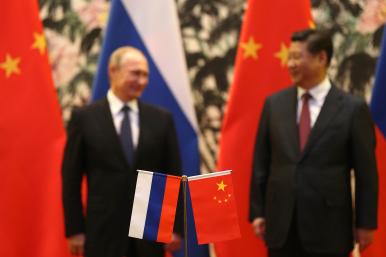
Russian President Vladimir Putin meets Chinese President Xi Jinping at a summit in Beijing - source: Reuters
Brief Analysis
Tracking Chinese and Russian Statements on the Iran War
A regularly updated compendium of Beijing and Moscow’s reactions to the fighting in Iran, Lebanon, and beyond, including analysis of the similarities and differences in their respective diplomatic approaches to the crisis.
April 2026
◆
  • Grant Rumley
  • Shivane Anand
Articles & Testimony
The Middle East After the Iran War: Lessons and Outcomes
However the conflict ends, it has already delivered pivotal lessons on U.S. military innovation and political strategy, the continued dominance of hydrocarbons, the future posture of regional and external powers, and more.
Mar 2026
◆
  • James Jeffrey
Photo of frozen Russian tanks in Ukraine.
Articles & Testimony
The War in Iran Could Become Like the War in Ukraine
Trump’s fifteen-point peace proposal suggests that he recognizes the need to find an off-ramp, but Washington must stay committed to that path to avoid a Russian-style quagmire.
Mar 27, 2026
◆
  • James Jeffrey
Close-up photo of Chinese leader Xi and Russian leader Putin.
Video
Brief Analysis
Great Power Competition During (and After) the Iran War
Three experts examine how Moscow, Beijing, and European capitals are navigating the crisis and what their choices reveal about the future of the global order.
Mar 19, 2026
◆
  • Anna Borshchevskaya
  • Souhire Medini
  • Henry Tugendhat
  • Grant Rumley
The national flags of China and Iran fly in Tiananmen Square during Iranian President Ebrahim Raisi's visit to Beijing, China, February 14, 2023 - source: Reuters
Articles & Testimony
How China Could Shorten Iran’s Path to Military Recovery After the War
Beijing has been mostly talk and little walk so far, but once the war ends, it may decide to help Tehran rebuild militarily in return for oil.
Mar 17, 2026
◆
  • Assaf Orion
Photo showing Ukraine's President Zelensky greeting Saudi officials on the tarmac.
Brief Analysis
Washington Should Jump on Ukraine’s Outreach to the Middle East
By offering military expertise and technology to the Gulf states, Kyiv has given the U.S. government a unique opportunity to counter Iran and Russia while boosting the security of American partners and forces in the region.
Mar 13, 2026
◆
  • Anna Borshchevskaya
  • Matthew Tavares
Brief Analysis
How Russia Benefits from Oil Disruption in the Gulf
The de facto halt to Gulf oil shipments has already helped Moscow win back India as a major oil customer, while the rise in global prices could greatly refresh its depleted Ukraine war budget.
Mar 11, 2026
◆
  • Noam Raydan
  • Anna Borshchevskaya
Articles & Testimony
The Middle East’s “1919” Moment
If the Iranian threat to the Middle East is brought to an end, the loose alliance of actors who have long sought this outcome must manage their differences to avoid the regional mistakes made after World War I.
Mar 10, 2026
◆
  • James Jeffrey
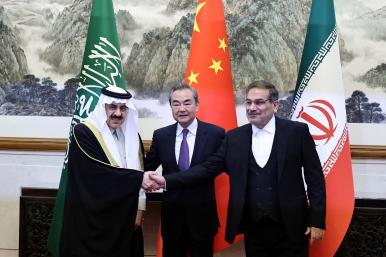
Wang Yi, director of China's Office of the Central Foreign Affairs Commission, Ali Shamkhani, secretary of Iran’s Supreme National Security Council, and Minister of State and national security adviser of Saudi Arabia Musaad bin Mohammed Al Aiban shake hands in Beijing in March 2023 - source: Reuters
Articles & Testimony
China’s Middle East Ties Go Far Beyond Iran
Beijing is just as concerned about its Gulf partners as it is about China’s “old friends” in Tehran.
Mar 10, 2026
◆
  • Henry Tugendhat
Brief Analysis
Great Power Spillover from the Iran War: Implications for China, Russia, Turkey, and Europe
Washington Institute experts explain what U.S. officials and military planners should be on the lookout for as great power competitors and close allies outside the region consider their responses to the crisis.
Mar 6, 2026
◆
  • Grant Rumley
  • Henry Tugendhat
  • Anna Borshchevskaya
  • Soner Cagaptay
  • Souhire Medini

Pagination

  • Current page 1
  • Page 2
  • Page 3
  • Page 4
  • Page 5
  • Page 6
  • Page 7
  • Page 8
  • Page 9
  • …
  • Last page Last »
  • Next page Next ›
Supported by the

Diane and Guilford Glazer Foundation Program on Great Power Competition and the Middle East

The Diane and Guilford Glazer Foundation Program on Great Power Competition and the Middle East focuses on the region as a setting for heightened competition between the United States and other world powers, such as China and Russia.

Sign Up for Email Updates from The Washington Institute

Never miss a breaking event on U.S. policy interests in the Middle East. Customize your subscription to our expert analysis, op-eds, live events, and special reports.


Sign up

Featured experts

Grant Rumley
Grant Rumley
Grant Rumley is the Meisel Family Senior Fellow and Director of the Diane and Guilford Glazer Foundation Program on Great Power Competition and the Middle East at the Washington Institute for Near East Policy.
Anna Borshchevskaya
Anna Borshchevskaya
Anna Borshchevskaya is the Harold Grinspoon Senior Fellow at The Washington Institute, focusing on Russia's policy toward the Middle East.
Michael Singh
Michael Singh
Michael Singh is the Managing Director and Steven D. Levy Senior Fellow at The Washington Institute.
Henry Tugendhat
Henry Tugendhat
Henry Tugendhat is a Senior Fellow in the Institute's Diane and Guilford Glazer Foundation Program on Great-Power Competition and the Middle East.
Background image with TWI branding
logo
wordmark
Homepage

1111 19th Street NW - Suite 500
Washington D.C. 20036
Tel: 202-452-0650
Fax: 202-223-5364

Footer contact links

  • Contact
  • Press Room
  • Subscribe

The Washington Institute seeks to advance a balanced and realistic understanding of American interests in the Middle East and to promote the policies that secure them.

The Institute is a 501(c)3 organization; all donations are tax-deductible.

Footer quick links

  • About TWI
  • Support the Institute
  • Alumni

Social media

  • The Washington Institute on Facebook facebook
  • The Washington Institute on X x
  • The Washington Institute on YouTube youtube
  • The Washington Institute on LinkedIn linkedin

© 2026 All rights reserved.

Footer

  • Employment
  • Privacy Policy
  • Rights & Permissions